
XENON: Florence After Dark
Florence is celebrated for its art, its architecture and the beauty of its past. Yet in the early 1980s, another side of the city came alive after sunset. In nearby Scandicci, a discotheque called XENON gave that world a name, a meeting place and a soundtrack of its own. Its story belongs to a moment when electronic music and new technology were changing the possibilities of a night out. Synthesizers brought unfamiliar sounds to the dance floor. Lasers transformed the space above it. Music, lighting and performance became parts of the same experience. XENON embraced that sense of possibility. Its ambition could be heard in the records created for the club and seen in an interior filled with colour, equipment and theatrical touches. It was a place with a distinctive personality, shaped by people who understood how much an evening could mean to those who came through its doors.
Marzio Dance and the Sound of XENON
At the heart of that personality stood Marzio Dance DJ, born Marzio Mugnaioni in Florence in 1954. After working at Valentinos, he became a central figure at XENON during its formative years. His presence behind the decks helped define the club, while his work in production carried its musical identity beyond the room itself. For Marzio, XENON was an important stage in a career that would eventually take him across Italy. Here, his activities expanded into recording, radio and television. The club provided a setting in which his musical imagination could develop, and his work helped give XENON a sound that people could recognise and remember. In 1982, his first single, The Adventure, became the club’s opening theme. Fabrizio Simoncioni and a young Marco Masini contributed to the music, helping create a record closely tied to the experience of an evening at XENON. An opening theme gives a venue something personal. Its first notes can become a greeting, a promise, the moment when the evening truly begins. For regular visitors, the music belongs to the place as surely as the entrance or the dance floor. At XENON, that connection was preserved on vinyl. In 1983 came Galaxi, followed by Symphony in 1984 and Opera in 1985. Each added another chapter to the club’s identity. Electronic rhythms met expansive melodies and theatrical flourishes, reflecting an appetite for music that could make the evening feel larger. Marzio’s involvement extended into the coordination and arrangement of these productions, with vocal contributions also appearing among his credits. His relationship with XENON connected the work of a DJ to the creation of music made specifically for the club. At the heart of that personality stood Marzio Dance DJ, born Marzio Mugnaioni in Florence in 1954. After working at Valentinos, he became a central figure at XENON during its formative years. His presence behind the decks helped define the club, while his work in production carried its musical identity beyond the room itself. For Marzio, XENON was an important stage in a career that would eventually take him across Italy. Here, his activities expanded into recording, radio and television. The club provided a setting in which his musical imagination could develop, and his work helped give XENON a sound that people could recognise and remember. In 1982, his first single, The Adventure, became the club’s opening theme. Fabrizio Simoncioni and a young Marco Masini contributed to the music, helping create a record closely tied to the experience of an evening at XENON. An opening theme gives a venue something personal. Its first notes can become a greeting, a promise, the moment when the evening truly begins. For regular visitors, the music belongs to the place as surely as the entrance or the dance floor. At XENON, that connection was preserved on vinyl. In 1983 came Galaxi, followed by Symphony in 1984 and Opera in 1985. Each added another chapter to the club’s identity. Electronic rhythms met expansive melodies and theatrical flourishes, reflecting an appetite for music that could make the evening feel larger. Marzio’s involvement extended into the coordination and arrangement of these productions, with vocal contributions also appearing among his credits. His relationship with XENON connected the work of a DJ to the creation of music made specifically for the club.
A Room Built for Spectacle
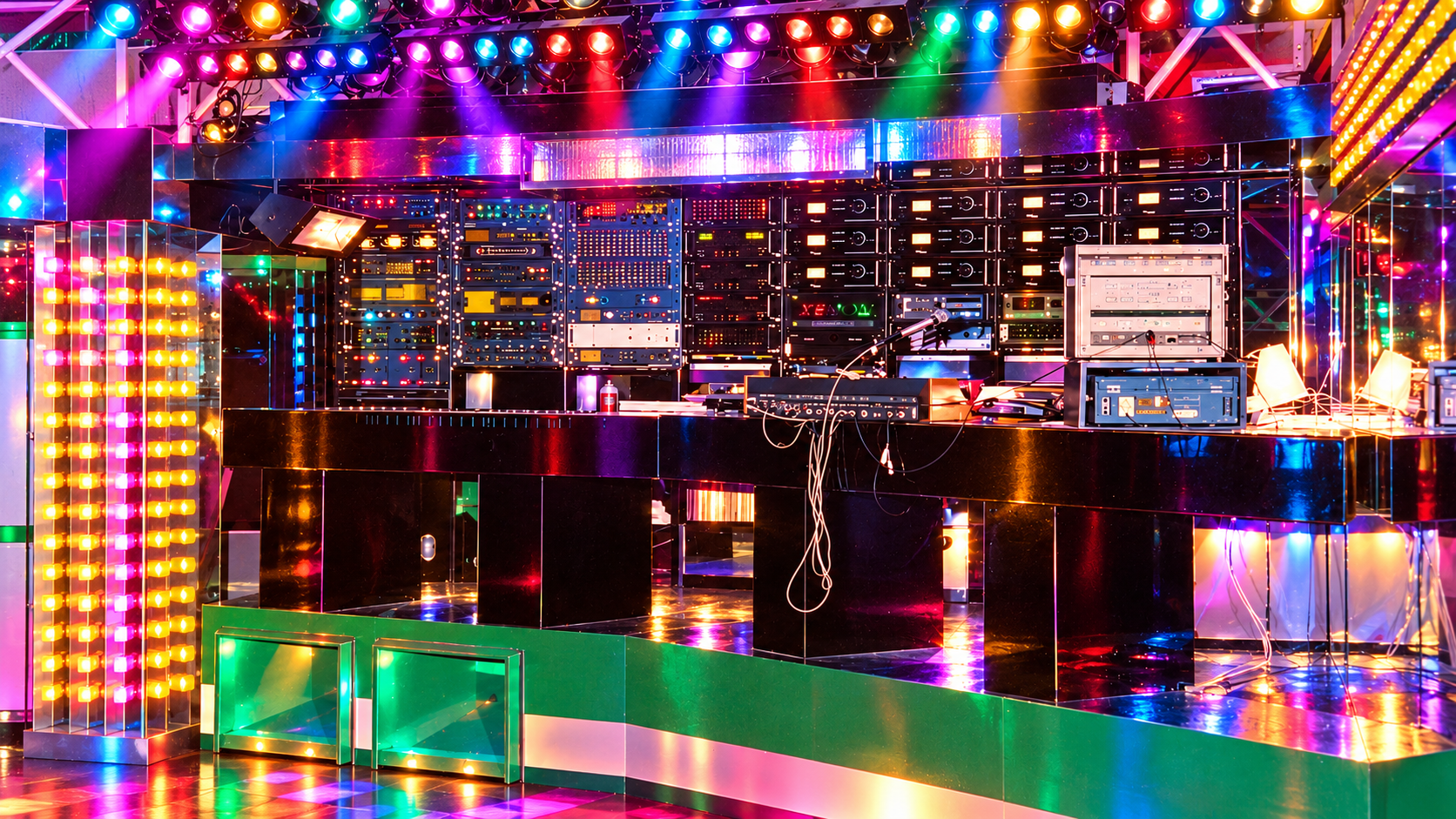
The surviving photographs reveal a distinctive interior. Green seating gathered around the dance floor, white railings framed the upper level, and banks of speakers and lighting equipment filled the space overhead. Above the room stood a metallic figure, identified in the accompanying description as a robotic doll. The technology was part of the club’s appeal. Its equipment included a Coherent laser rated at eight watts, with water cooling and a stated electrical demand of fifteen kilowatts. A luminous dance floor, magnesium flashes and a wide variety of lights added to the spectacle. These details capture the scale of the effort behind an evening at XENON. The laser required substantial equipment and power. The illuminated floor made light part of the surface on which people danced. The robotic figure gave the room another memorable feature. Together, they expressed a fascination with the future that suited the club’s electronic soundtrack. Another photograph shows bottles beneath a large neon guitar carrying the XENON name. It is a striking piece of visual identity, playful and immediately recognisable. Even in a still photograph, it gives the bar a character of its own.
The People Behind the Night
XENON’s atmosphere depended on a whole team. Tiziano Fanfani and Carlo Piccini were named in its management, with Filippo Bologna at the entrance cashier, Tiziana Fanfani responsible for the cloakroom and Marco Raffaelli, known as Raffa, handling security. The musical history also includes Mario Mangiarano, known as Greco’s, listed as DJ in 1985. Guest names included Enrico Tagliaferri, Riccardo Cioni and Federico l’Olandese Volante. Andrea Alfani, known as Gega, worked on the laser project, while Marco Benedetti was named as light jockey. Supporting DJs and lighting staff contributed to the progression of the evenings, including the music leading up to the club’s signature opening. Remembering these people gives the story its human dimension. A successful night began well before the dance floor filled. Someone welcomed the visitors, someone looked after their coats, someone prepared the music, and someone made the lights come alive at the right moment. Marzio was a central part of XENON’s success, supported by a team whose combined work made the club possible.
Artists, Television and a Wider Audience
XENON’s stage welcomed a broad range of performers. The names preserved in its photographic history include Zucchero, Loredana Bertè, Nomadi, Depeche Mode, Milva, Kano, P. Lion, Den Harrow, Electric Mind, Visage, Raf, Scialpi and Martinelli. That variety placed Italian popular music alongside electronic acts and international artists, giving the venue a musical life that extended beyond its own records. In October 1983, the television programme Discoring featured an edition from XENON. Depeche Mode performed Everything Counts, alongside appearances by artists including Naked Eyes, Milva and Banco. The broadcast left a recorded glimpse of the club during a formative period for electronic pop. XENON also had a weekly television programme on Tele 37, called Disco Xenon and presented by Gianni Pierantozzi. Radio Studio 54 was another part of its media connections. The club’s presence therefore reached into people’s homes as well as their evenings out. Television and radio helped carry the XENON name beyond Scandicci, while its records gave listeners something they could return to whenever they wished.
The Music That Remained
Marzio eventually moved on to other Italian clubs and later became closely associated with Luna 72 in Portogruaro, followed by its chapters as TNT and TNT Kamasutra. XENON remained an important foundation in that journey, a place where his work behind the decks had grown into a wider creative career. His death in 2013 added poignancy to the music he left behind. The XENON recordings preserve part of his imagination and energy, together with the contributions of the musicians who worked alongside him. The affection for the club had already become clear in 2010, when a reunion in Florence brought former collaborators together for music, historical footage and appearances by Rockets and Santa Esmeralda. Years had passed, but the name still connected people to a shared period of their lives. Today, the photographs make that world visible again. The neon guitar, green seating, white railings and equipment above the floor give shape to a place that otherwise might survive mainly through its music. And the music still matters. The Adventure, Galaxi, Symphony and Opera carry the identity of XENON across the decades. They preserve the ambition of a club and the creative partnership between Marzio Dance and the people around him. For those who were there, the memories will be more personal. A familiar face beside the dance floor. The anticipation before the opening theme. The moment the lights changed and the room seemed to change with them. In a city famous for preserving the past, XENON gave a generation somewhere to imagine the future. For those who remember it, that future still begins with the opening notes.
XENON Lives On in the Mix
The music is still here, ready to bring a little of XENON back to life. In 2023, I created XGOS, a mashup bringing together three of the club’s signature themes: Galaxi from 1983, Symphony from 1984 and Opera from 1985. Each captures a different part of XENON’s musical identity and the creative spirit of Marzio Dance and his collaborators. My idea was to weave these three productions into one continuous journey, celebrating the melodies, atmosphere and imagination that made them memorable. Why bring them together? Because I had never heard them combined this way before, and I wanted to explore how they would sound as one. Here is my tribute to XENON, made with affection for the music and the people who gave the club its character.
XGOS: Galaxi, Opera & Symphony. A XENON mashup, created in 2023.


